

Best Non GamStop Casino UK 2026
Loading...
Every UKGC-licensed casino in Britain feeds into one system — and that system decides whether you can play. GamStop, the national self-exclusion scheme, has been mandatory for all UK Gambling Commission licence holders since March 2020 (source). Register once, and every domestic online casino, sportsbook, and bingo site locks you out for a minimum of six months. No exceptions, no early cancellations, no appeals until the clock runs down.
Non-GamStop casino sites exist outside that framework entirely. These are offshore-licensed platforms — regulated by jurisdictions such as Curaçao, Malta, Gibraltar, or Anjouan — that are not connected to the GamStop database and are not bound by UKGC rules. They accept UK players, they process GBP deposits, and they operate under their own regulatory standards. Whether those standards match what the UKGC demands is a different question, and one this guide addresses head-on.
The audience for non-GamStop casinos is broader than most people assume. Yes, some players are self-excluded and looking for a way back to the tables. But a growing segment of UK gamblers are turning to offshore platforms for reasons that have nothing to do with self-exclusion. The UKGC's regulatory tightening across 2025 and into 2026 — stake caps, mandatory spin delays, affordability checks triggered at relatively low thresholds, wagering requirement ceilings, and the removal of popular game features like bonus buy and autoplay — has pushed players toward platforms where those restrictions do not apply.
This is not a ranked list of casinos with affiliate links and star ratings. It is a structural guide to how non-GamStop casino sites work, what protections exist (and which ones do not), how to evaluate whether an offshore platform is trustworthy, and what the real differences are between playing inside and outside the UKGC ecosystem. The goal is to give you enough information to make a decision that is informed rather than impulsive — because offshore freedom and offshore risk come packaged together.
What Is GamStop and Why Does It Exist?
GamStop was not born in a vacuum. It was the UKGC's answer to a self-exclusion patchwork that was not working. Before GamStop, each operator ran its own self-exclusion process independently. A player could ban themselves from one casino and sign up at a competitor ten minutes later. The system was fragmented, inconsistent, and largely ineffective for anyone with a genuine gambling problem.
GamStop — the UK's national online self-exclusion scheme, operated by The National Online Self-Exclusion Scheme Limited. Players register at gamstop.co.uk with their name, date of birth, email, and postcode. Once active, all UKGC-licensed online gambling operators are required to block that individual from accessing their platforms. Registration is free. Duration options: 6 months, 1 year, or 5 years. As of the end of 2024, more than 532,000 people in the UK had registered — over 1% of the adult population (source).

The scheme soft-launched in April 2018, with full mandatory integration completed by March 2020 (source). Every operator holding a UKGC licence must participate. When a player registers with GamStop, the system cross-references their details against operator databases in near-real-time. Attempting to create a new account at any participating site triggers a block. Attempting to log into an existing account triggers the same block.
Three exclusion periods are available: six months, one year, and five years. The critical detail that catches many users off guard is the removal process. Self-exclusion cannot be cancelled early under any circumstances. When the chosen period expires, removal is not automatic. The player must contact GamStop directly to request reinstatement, and even then a 24-hour cooling-off period applies before access is restored. Some players report delays well beyond that window, particularly when operator databases are slow to update.
The scheme covers all UKGC-licensed online gambling — casinos, sportsbooks, bingo sites, poker rooms, lottery platforms. It does not cover land-based venues, the National Lottery, or any gambling operator licensed outside the UK. That last point is the entire reason non-GamStop casinos exist as a category. Offshore platforms sit outside the UKGC's regulatory perimeter, which means they have no obligation to query the GamStop database and no mechanism to do so even if they wanted to. For players locked out of domestic platforms — whether by choice or by frustration with UKGC rules — those offshore sites represent the only online gambling option available.
How Non-GamStop Casinos Operate Outside UK Regulation
Offshore does not mean unregulated — it means regulated differently. Non-GamStop casinos hold gambling licences issued by jurisdictions outside the United Kingdom. They are legal businesses operating under the laws of their licensing country, serving an international player base that often includes British residents. The distinction that matters is jurisdictional: because they do not hold a UKGC licence, they are not required to integrate with GamStop, enforce UKGC-specific player protection rules, or comply with the raft of gameplay restrictions that apply to domestic operators.
Offshore gambling licence — a regulatory permit issued by a government or gaming authority outside the United Kingdom, authorising an operator to offer real-money gambling services to players in multiple jurisdictions. The licence defines the operator's obligations regarding player funds protection, game fairness, anti-money laundering compliance, and dispute resolution.
Key Licensing Jurisdictions: Curaçao, MGA, Gibraltar, Anjouan
The four jurisdictions most commonly encountered at non-GamStop casinos serving UK players each operate with different levels of regulatory rigour.
Curaçao (CGA) is the most prevalent. The Curaçao Gaming Authority (formerly Gaming Control Board) oversees operators under a licensing framework that was substantially reformed between 2023 and 2025, culminating in the new National Ordinance on Games of Chance (LOK) enacted in December 2024 (source). Historically, Curaçao licences were criticised for light-touch enforcement and limited player recourse. The reforms introduced individual operator licensing (replacing the old master-licence sublicensing model), stricter AML requirements, and mandatory RNG certification. Whether enforcement has caught up with the new rules remains an open question.
Malta Gaming Authority (MGA) is widely regarded as the strongest offshore regulator for European-facing gambling. MGA-licensed casinos must segregate player funds, submit to regular compliance audits, and participate in an Alternative Dispute Resolution (ADR) process. For UK players accustomed to UKGC protections, MGA is the closest equivalent available at a non-GamStop site.
Gibraltar is a British Overseas Territory with a compact but well-regulated gambling sector. Gibraltar licences are expensive and difficult to obtain, which keeps the number of licensees small but the quality relatively high. Several large operators — including some household names in UK gambling — hold Gibraltar licences alongside or instead of UKGC ones.
Anjouan is the newest entrant, having launched its gaming authority in recent years. It operates with lower barriers to entry, and its regulatory track record is still too short to evaluate meaningfully. Players should treat Anjouan-licensed casinos with more caution than those holding MGA or Gibraltar credentials.
How Offshore Casinos Accept UK Players Legally
The legal framework governing this arrangement is covered in detail in the section below. The short version: UK law regulates operators, not players, and there is no offence committed by a British resident who gambles at an offshore-licensed site.
In practice, offshore casinos accept UK players by operating under their non-UK licence, processing deposits in GBP or cryptocurrency, and making no attempt to verify GamStop status (which they cannot access). The player signs up, deposits funds, and plays — without the identity verification gatekeeping that UKGC sites now require before a single spin. Most offshore operators do eventually conduct KYC checks, but typically only at the point of first withdrawal rather than at registration.
Is It Legal for UK Players to Use Non-GamStop Casinos?
The law targets operators, not players — but that distinction deserves a closer reading than most guides offer.
Under the Gambling Act 2005, it is a criminal offence to provide gambling services to persons in Great Britain without a licence issued by the Gambling Commission, or to advertise such services to UK consumers. The penalties apply to the operator: fines, prosecution, and domain blocking. There is no equivalent provision that criminalises the act of gambling by a UK resident at an offshore site. Put plainly, a British player who registers at a Curaçao-licensed casino, deposits funds, and plays slots is not committing an offence.
That legal reality is clear, but it comes with practical caveats that are worth understanding.
First, the absence of criminal liability does not mean the absence of risk. If a dispute arises — a refused withdrawal, a confiscated balance, a bonus term applied retroactively — the player has no recourse through the UK's regulatory framework. The UKGC cannot intervene because the operator is not its licensee. UK-based Alternative Dispute Resolution services, which handle complaints against UKGC-licensed casinos, have no jurisdiction over offshore operators. The player's only option is to pursue a complaint through whatever dispute mechanism the licensing jurisdiction provides, and the quality of that mechanism varies wildly depending on whether the casino holds an MGA licence (robust ADR process) or a Curaçao one (limited and often slow).
Important: If something goes wrong at a non-GamStop casino — a frozen account, a disputed payout, a suspected rigged game — you cannot file a complaint with the UK Gambling Commission or use UK-based ADR services. Your only avenue is the regulator in the casino's licensing jurisdiction. Before you deposit, know which regulator that is and how their complaints process works.
Second, while players face no criminal penalty, their financial institutions may take a different view. UK banks and payment processors increasingly monitor transactions to gambling sites, particularly those without UKGC licences. Some banks will block card payments to offshore operators outright. Others may flag repeated gambling transactions as part of their own responsible lending assessments. This is not a legal issue per se, but it can create friction that players do not anticipate.
Third, the UKGC has been progressively tightening the space around offshore operators. Advertising restrictions have been enforced more aggressively, and the Commission has worked with internet service providers to block unlicensed sites on multiple occasions. While this does not directly affect the player, it does mean that the landscape of accessible non-GamStop casinos can shift — a site that is reachable today may be blocked tomorrow if the UKGC successfully requests a domain takedown.
The bottom line: using a non-GamStop casino is legal for UK players. But legal is not the same as protected. The freedoms are real, and so are the gaps in the safety net.
UKGC-Regulated Casinos vs Non-GamStop Sites: What Actually Changes
Two casinos can host the same slot title from the same provider — and the UK version plays like a different game. The divergence between UKGC-regulated platforms and offshore non-GamStop sites has widened sharply over the past eighteen months, driven by a series of regulatory interventions that fundamentally altered the British online gambling experience.
| Feature | UKGC Regulated | Non-GamStop Offshore |
|---|---|---|
| Maximum stake per spin (slots) | £5 (£2 if aged 18–24) (source) | No universal cap — operator-set, often £100+ |
| Spin speed | Minimum 2.5-second cycle (slots); 5-second cycle (other casino games since January 2025) (source) | No mandatory delay — turbo mode available |
| Bonus buy feature | Banned | Available on most titles |
| Autoplay | Banned | Available |
| Max wagering requirement | Capped at 10x (since January 2026) (source) | No cap — commonly 30x–50x |
| Affordability checks | Triggered at £150/month net deposit (source) | None required |
| Cross-product bonuses | Banned since January 2026 (source) | Available — e.g. free spins for sports bets |
| KYC timing | Before first deposit | Typically at first withdrawal |
| Self-exclusion | GamStop mandatory | Voluntary, casino-level only |
| Dispute resolution | UK-based ADR services | Licensing jurisdiction's process |
Bonus Caps and Wagering Requirements
The January 2026 wagering requirement cap is perhaps the most commercially significant change the UKGC has introduced. UK-licensed casinos can no longer impose wagering requirements above 10x on any bonus (source). A £50 bonus with 10x wagering means the player must bet through £500 before withdrawing — a figure that is realistically clearable.

Offshore casinos operate under no such restriction. Welcome bonuses at non-GamStop sites routinely carry wagering requirements of 35x to 50x, and some push beyond 60x. The headline bonus figure is often larger — 100% up to £1,000 instead of 100% up to £200 — but the playthrough demand transforms that generous-looking number into a very different proposition. A £500 bonus at 40x wagering requires £20,000 in total bets before a single penny can be withdrawn. The UKGC's cap makes domestic bonuses smaller but more achievable. Offshore bonuses are bigger but statistically harder to convert into real money.
The January 2026 ban on cross-product bonuses added another layer (source). UKGC casinos can no longer offer casino free spins as a reward for placing sports bets, or vice versa. Offshore platforms still bundle these freely, which appeals to players who use both casino and sportsbook products under one account.
Spin Speed, Stake Limits, and Feature Bans
UKGC-licensed slots enforce a mandatory 2.5-second minimum game cycle (in effect since October 2021; source). Since April 2025, the maximum stake per spin is £5 for players aged 25 and over, dropping to £2 for those aged 18–24 (source). Bonus buy features — where a player pays a lump sum (often 80x to 100x the base stake) to skip directly to a slot's bonus round — have been banned entirely. Autoplay, which allowed players to set a number of automated spins, is also gone from UK sites.
At non-GamStop casinos, none of these restrictions apply. Players can spin as fast as the game engine allows, stake as high as the operator permits (which can run into hundreds of pounds per spin), buy bonus rounds on titles like Sweet Bonanza or Mental, and set autoplay to run indefinitely. The game itself — the same title from the same provider — behaves differently depending on which regulatory regime governs the platform hosting it.
KYC and Affordability Checks
UKGC operators must verify a player's identity before allowing the first deposit. This typically involves submitting photo ID, proof of address, and in some cases source-of-funds documentation. Since February 2025, any player depositing more than £150 net in a single month triggers a light-touch financial vulnerability check, during which publicly available data such as bankruptcy records and county court judgments is assessed (source).
Non-GamStop casinos generally delay identity verification until the player requests their first withdrawal. Registration is lightweight — name, email, password — and deposits can be made immediately. This speed and convenience is one of the primary draws of offshore platforms, though it comes with a trade-off: if KYC issues arise at withdrawal time, the player may face delays or complications after their money is already in the system.
Knowing the differences is one thing — knowing how to protect yourself within those differences is what actually matters.
How to Verify a Non-GamStop Casino Is Safe
A Curaçao licence number at the footer means nothing until you have punched it into the regulator's public register and confirmed it matches the operator running the site. Safety verification at non-GamStop casinos requires a level of due diligence that UKGC-licensed platforms handle automatically — because the UKGC has already done the vetting. Offshore, that responsibility shifts to the player.
Checking Licence Validity Step by Step
Every legitimate non-GamStop casino displays its licensing information, usually at the bottom of the homepage. The minimum you should find is the name of the regulatory authority, a licence number, and in many cases a clickable verification seal. Do not take the casino's word for it. The verification process is straightforward and should take less than two minutes.
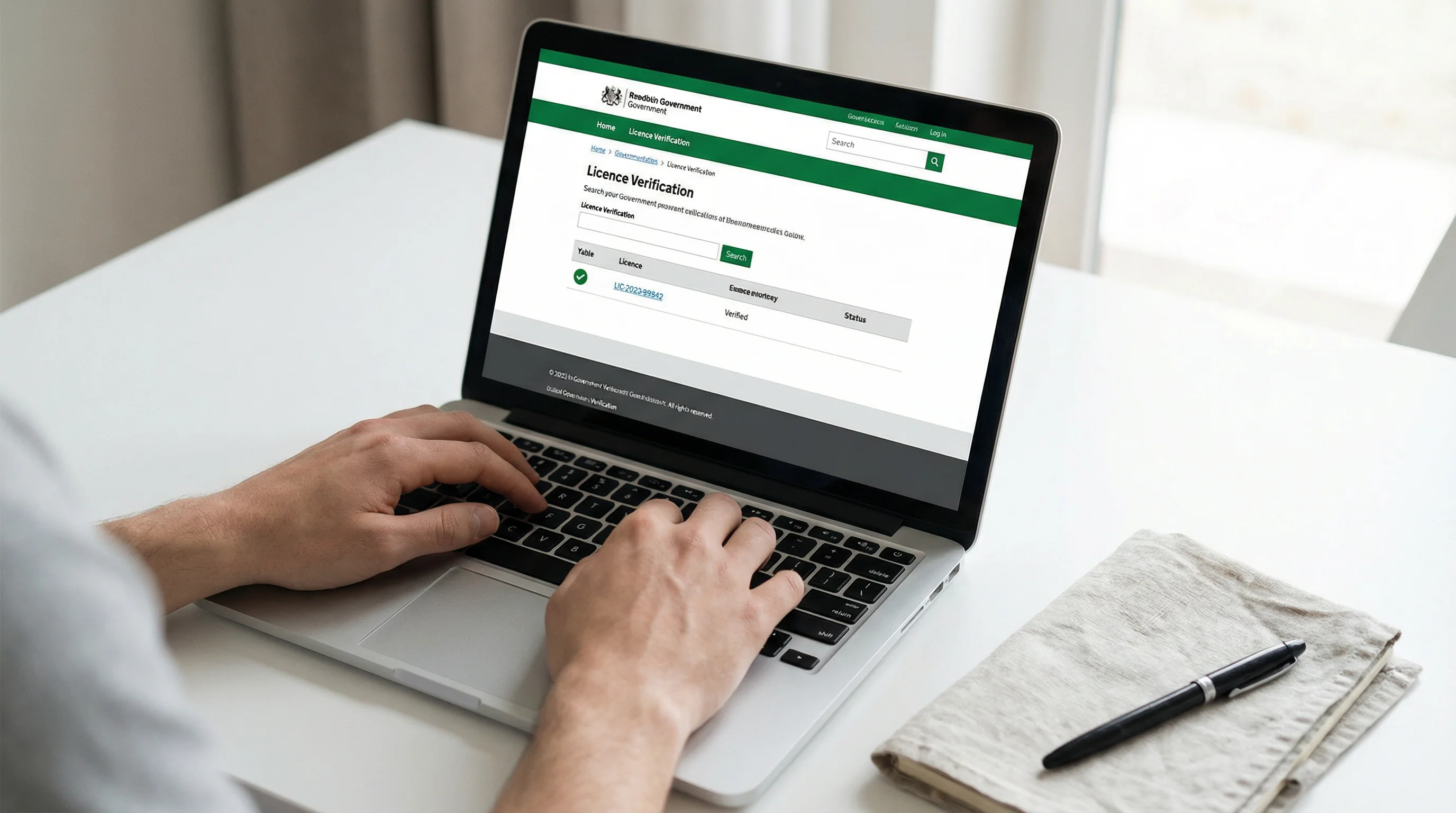
For Curaçao-licensed casinos, visit the Curaçao Gaming Authority's website (cga.cw) and use their licence verification tool. Enter the licence number and confirm that the registered entity matches the casino you intend to use. For MGA-licensed operators, the Malta Gaming Authority publishes a searchable register of all active licensees at mga.org.mt. Gibraltar's licensing authority maintains a similar public list. If you cannot find the casino's licence number in the relevant register — or if the number exists but is attached to a different company — that is a definitive red flag and you should not proceed.
Pay attention to the licence status, not just its existence. Licences can be suspended, revoked, or expired. A casino displaying a licence that is no longer active is operating illegally under its own jurisdiction's rules.
SSL, RNG Audits, and Payment Provider Quality
Beyond licensing, three technical signals provide useful safety information.
First, check the browser address bar. The URL should begin with https:// and display a padlock icon indicating an active SSL certificate. This encrypts data transmitted between your device and the casino's servers. Any site handling financial transactions without SSL encryption should be avoided immediately.
Second, look for evidence of third-party game auditing. Reputable non-GamStop casinos work with independent testing laboratories — eCOGRA, iTech Labs, GLI, or BMM Testlabs — to certify the fairness of their random number generators. The casino may display an audit seal on its homepage or reference the testing lab in its terms and conditions. As with licensing, verify the seal independently if possible.
Third, examine the payment options available. Casinos that work with established payment processors — Visa, Mastercard, Skrill, Neteller, recognised cryptocurrency networks — have passed at least a basic level of commercial vetting. Payment providers conduct their own due diligence on the merchants they service. A casino that accepts only obscure payment methods or unnamed crypto tokens should raise immediate concern.
Do
- Verify the licence number on the regulator's official website before depositing
- Check for HTTPS and a valid SSL certificate in your browser
- Test customer support with a question before committing any funds
- Read player reviews on independent forums — look for patterns, not individual complaints
- Start with a small test deposit and attempt a withdrawal early
Don't
- Deposit a large sum on your first visit to any new offshore casino
- Ignore a missing or unverifiable licence — no amount of bonuses compensates for no regulatory oversight
- Skip the bonus terms and conditions — the wagering clause determines whether the bonus has real value
- Rely on testimonials published on the casino's own site — they are curated marketing material
- Assume that crypto-only casinos are automatically safer or more private
Bonuses at Non-GamStop Casinos: What UK Players Actually Get
A 200% match up to £2,000 sounds spectacular — until you read the 45x wagering clause beneath it. Non-GamStop casino bonuses are consistently larger in headline terms than anything UKGC-licensed sites can offer, particularly after the domestic wagering cap took effect. But the size of a bonus and the value of a bonus are fundamentally different things, and confusing the two is the most expensive mistake a player can make at an offshore casino.
Welcome Packages and Deposit Matches
The standard welcome offer at a non-GamStop casino follows a familiar structure: a percentage match on the player's first deposit, sometimes extended across the first two, three, or even five deposits. Match percentages of 100% are common at the first tier, with some casinos pushing to 150% or 200%. Maximum bonus amounts range from £300 at the conservative end to £2,000 or more at high-roller-oriented platforms.
The critical variable is the wagering requirement — the multiple of the bonus amount (and sometimes the deposit) that must be bet before any winnings can be withdrawn. At UKGC sites, this is now capped at 10x. At non-GamStop casinos, there is no cap. Requirements of 30x to 50x are the norm, with some operators setting the bar at 60x or higher.
Bonus Playthrough Calculation
Deposit: £200
Bonus: 100% match = £200
Wagering requirement: 40x (on bonus only)
Total playthrough needed: £200 x 40 = £8,000
At a slot with 96% RTP, expected return per £100 wagered = £96
Expected balance after £8,000 wagered: approximately £200 x 0.96^80 ≈ significantly below the original deposit
Realistic outcome: the vast majority of players will not clear this wagering before the bonus expires or the balance reaches zero.
The maths are not designed to be generous. They are designed to keep the player engaged while the house edge erodes the bonus balance over thousands of required bets. This does not mean every bonus is worthless — a player on a fortunate variance swing can clear high wagering requirements. But statistically, the higher the multiplier, the lower the probability of converting bonus funds into withdrawable cash.
Cashback, Free Spins, and Loyalty Programmes
Beyond welcome packages, non-GamStop casinos compete on ongoing promotions. Cashback offers — typically 5% to 20% of net losses returned over a set period — are among the most common. At offshore sites, cashback is usually credited as bonus funds with their own wagering requirements, not as withdrawable cash. This contrasts with UKGC-regulated casinos, where current rules require cashback to be paid as real money.
Free spins are distributed liberally, both as part of welcome packages and as standalone daily or weekly offers. The value of a free spin depends on the fixed bet size, the game's RTP, and the wagering imposed on any winnings. Ten free spins at £0.10 each on a 95% RTP slot carry an expected value of approximately £0.95 before wagering — meaningful only in volume.
Loyalty programmes at offshore casinos tend to be more elaborate than their UKGC counterparts, with tiered VIP systems that reward sustained play with improved withdrawal limits, dedicated account managers, birthday bonuses, and event invitations. The appeal is genuine, but it is worth remembering that the only way to climb a VIP ladder is to wager more — and the house edge applies to every bet, regardless of your tier.
Payment Methods: How Money Moves at Non-GamStop Sites
The banking page tells you more about a casino's legitimacy than its "About Us" section ever will. Non-GamStop casinos typically offer a wider range of deposit and withdrawal options than UKGC-licensed platforms, partly because offshore regulators impose fewer restrictions on payment processing and partly because the international player base demands variety. For UK players, the practical question is which methods actually work reliably — because not all of them do.
Cryptocurrency

BTC, ETH, LTC, USDT
Deposit: instant after confirmation
Withdrawal: minutes to hours
Fees: network fees only
E-Wallets
Skrill, Neteller, Payz
Deposit: instant
Withdrawal: 24–48 hours
Fees: 0–2.5%
Debit Cards
Visa, Mastercard
Deposit: instant
Withdrawal: 1–5 business days
Fees: usually none
Bank Transfer
Direct wire / SEPA
Deposit: 1–3 business days
Withdrawal: 3–5 business days
Fees: 0–3%
Cryptocurrency has become the default payment method at many non-GamStop casinos, and for practical reasons. Crypto transactions bypass the banking intermediaries that increasingly block payments to offshore gambling sites. Bitcoin deposits confirm on the blockchain within minutes, and withdrawals are processed directly to the player's wallet without waiting for bank clearance. The trade-off is volatility: your deposited BTC may be worth more or less by the time you withdraw, and the casino may convert to a stablecoin or fiat internally at a rate you do not control.
E-wallets — Skrill, Neteller, and Payz are the most widely supported at offshore casinos. PayPal, despite its popularity in UK commerce, is largely unavailable at non-GamStop sites because PayPal restricts transactions to operators without UKGC or similarly recognised licences. Skrill and Neteller apply fewer such restrictions and are the preferred fiat e-wallet options for offshore gambling. Deposits are instant; withdrawals typically process within 24 to 48 hours. Both services charge fees on certain transaction types, so check the fee schedule before selecting them as your primary method.
Debit cards — Visa and Mastercard remain accepted at many non-GamStop casinos, but reliability varies. Some UK banks proactively block gambling transactions to non-UKGC sites, meaning a card deposit may be declined even if the casino accepts it in principle. If your bank blocks the transaction, the casino cannot override it. Players who encounter this issue typically switch to e-wallets or crypto as intermediary methods.
Bank transfers are the slowest option but often carry the highest transaction limits, making them the preferred route for high-value deposits and withdrawals. Processing times of three to five business days are standard, and some casinos impose a percentage fee on wire transfer withdrawals.
Whichever method you use, the real test is the withdrawal. Depositing is straightforward at virtually every casino. Withdrawing — quickly, without friction, in full — is where you learn whether the platform is trustworthy.
Games Available at UK Casino Sites Not on GamStop
Without UKGC game modifications, you are playing the developer's original build — bonus buys, turbo spins, and all. This is arguably the single biggest draw of non-GamStop casinos for players who are not motivated by self-exclusion avoidance. The games look the same, carry the same titles, come from the same studios — but the UKGC-compliant versions have been materially altered to conform with British regulations, while the offshore versions run exactly as the developers designed them.
Slots Not on GamStop: Providers and Features
The major slot providers — Pragmatic Play, Hacksaw Gaming, Nolimit City, Push Gaming, Play'n GO, ELK Studios, and Relax Gaming — all supply titles to non-GamStop casinos. Many of these studios have built their reputations on high-volatility mechanics that rely heavily on features the UKGC has banned: bonus buy, where a player pays a premium (often 80x to 100x the base stake) to trigger the bonus round immediately; turbo and rapid-fire spin modes that eliminate the mandated 2.5-second game cycle; and autoplay, which allows extended unattended sessions.
Titles like Sweet Bonanza, Gates of Olympus, Mental, San Quentin, and Tombstone RIP are technically available on both UKGC and offshore platforms. But the UK versions strip out the bonus buy button, enforce the spin delay, and disable autoplay — altering the gameplay rhythm that made these titles popular in the first place. For players who specifically enjoy high-volatility, feature-rich slots, the offshore versions are objectively closer to the intended product.
A typical UKGC-licensed casino offers between 800 and 1,500 slot titles. A large non-GamStop casino may host 3,000 to 5,000 — not because they work with more providers, but because they are not required to exclude titles that fail UKGC compliance tests for stake limits, volatility labelling, or feature restrictions.
RTP — return to player — is theoretically identical across jurisdictions for the same game version, but some providers offer configurable RTP settings that allow casinos to select from multiple payout tiers. A slot might default to 96.5% RTP but be available at 94% or 92% at the operator's discretion. Reputable offshore casinos publish their RTP configurations or link to the provider's certified game rules. Those that do not should be treated with scepticism.
Live Casino Tables and Game Shows
Live dealer gaming at non-GamStop casinos is supplied overwhelmingly by Evolution Gaming, with Pragmatic Play Live and Ezugi filling supporting roles. The product is streamed in real time from professional studios, with human dealers managing physical cards, wheels, and game equipment. For UK players, the live casino experience at an offshore site is nearly indistinguishable from what UKGC-licensed platforms offer — because the streams originate from the same studios and feature the same dealers.
The differences are regulatory rather than experiential. UKGC sites are required to display responsible gambling messaging during live play, enforce session time pop-ups, and restrict maximum bet sizes. Offshore live tables have none of these interruptions. Stake limits tend to be higher, and the range of available tables is often broader, including VIP and high-roller rooms that UKGC sites have scaled back in response to regulatory pressure on high-value player management.
Game shows — Crazy Time, Monopoly Live, Dream Catcher, and similar titles from Evolution — are available at most non-GamStop casinos with full functionality. These combine live hosting with RNG-driven bonus segments and have become a significant traffic driver for offshore platforms.
Responsible Gambling Without GamStop: Tools That Still Exist
Stepping outside the UKGC ecosystem does not mean stepping away from every safety tool available. It does, however, mean that the tools are no longer mandatory — and that the responsibility for activating them shifts squarely to the player.
The most powerful external tool is BetBlocker, a free application distributed by a UK-registered charity. BetBlocker installs on any device — Windows, Mac, Linux, iOS, Android — and blocks access to over 85,000 gambling websites (source). Unlike GamStop, which relies on operator cooperation, BetBlocker works at the device level by preventing the browser from loading gambling domains, regardless of where those sites are licensed. It blocks UKGC casinos, Curaçao casinos, unregulated casinos — everything. For anyone who wants a comprehensive block without relying on any single operator or regulatory framework, BetBlocker is the most effective option currently available.

Gamban operates on a similar principle, blocking gambling sites and apps across all devices linked to the user's subscription. It is a paid service (with hardship exemptions available) and covers a regularly updated database of gambling domains. Gamban runs in the background and is designed to be difficult to circumvent, making it a robust layer of protection for players who struggle with impulse control.
GamCare provides free counselling, support, and practical advice for anyone affected by gambling harm (gamcare.org.uk). Their helpline (0808 8020 133) and live chat service are available to UK residents regardless of where they gamble. GamCare does not block sites or restrict access — it offers human support, including structured treatment programmes, group therapy, and signposting to the NHS National Gambling Treatment Service. If gambling is causing financial, emotional, or relational harm, GamCare should be your first point of contact.
At the casino level, many reputable non-GamStop operators offer their own responsible gambling tools. Deposit limits, loss limits, session time reminders, and cooling-off periods are available at most MGA- and Gibraltar-licensed sites. Some Curaçao-licensed operators also provide these features, though compliance is less consistent. The key difference from UKGC sites is that these tools are opt-in rather than default. The casino will not prompt you to set a deposit limit during registration. You need to find the responsible gambling section in your account settings and configure the limits yourself.
One point that needs stating without qualification: if you registered with GamStop because gambling was causing you harm — financial loss, relationship damage, emotional distress — non-GamStop casinos are not the answer. GamStop exists as a protection mechanism, and circumventing it reintroduces the exact risk it was designed to mitigate. The tools listed above are meant for players who are in control of their gambling but want additional safeguards. They are not workarounds for people in crisis. If you are in crisis, speak to GamCare or call the National Gambling Helpline.
Mobile Casino Experience Beyond GamStop
Most offshore casinos now run as PWAs — progressive web applications that load in the mobile browser, function like native apps, and require no download from an app store. This is not a technical workaround; it is a deliberate design choice. Apple and Google both restrict real-money gambling apps in their stores, particularly for operators without a UKGC licence. By building browser-based PWAs, non-GamStop casinos bypass app store gatekeeping entirely while delivering a user experience that is, for practical purposes, indistinguishable from a downloaded app.
The quality of that experience varies considerably. Well-built offshore sites offer responsive design that adapts to screen size, touch-optimised navigation, and game lobbies that load quickly over 4G and 5G connections. Slots and table games from major providers are designed mobile-first, and live dealer streams are optimised for smaller screens with adaptive video quality. The better non-GamStop casinos implement thumb-reach navigation patterns — menus, deposit buttons, and game categories positioned within easy reach of a single-hand grip.
Less polished operators deliver a noticeably worse mobile experience: slow load times, poorly scaled game interfaces, deposit forms that do not render correctly on smaller screens, and customer support chat widgets that obscure half the page. The gap between good and bad mobile implementation is wider at offshore casinos than at UKGC sites, where the Gambling Commission's technical standards enforce a baseline of usability.
One genuine mobile advantage at non-GamStop casinos is the absence of UKGC-mandated interruptions. UK-licensed mobile casinos are required to display responsible gambling pop-ups at regular intervals during play, insert affordability check prompts, and restrict certain interface elements. Offshore mobile casinos have none of these enforced pauses. Whether that is a benefit or a risk depends entirely on the player — uninterrupted sessions are more enjoyable, but they are also more conducive to losing track of time and spend.
For mobile payment processing, most non-GamStop casinos support the same methods available on desktop. Crypto wallets, e-wallet apps (Skrill and Neteller both have mobile apps), and card payments all function through the mobile browser. Apple Pay and Google Pay support is growing but remains inconsistent at offshore platforms — check before assuming your preferred mobile payment method is available.
Frequently Asked Questions About Non-GamStop Casino Sites
Are non-GamStop casinos legal for UK players?
Yes, using a non-GamStop casino is legal for UK players. The Gambling Act 2005 places regulatory obligations and criminal penalties on operators, not on individual players. It is an offence for an unlicensed operator to advertise to UK consumers, but there is no corresponding offence for a UK resident who chooses to gamble at an offshore platform. The casino itself must comply with the laws of the jurisdiction where it is licensed — Curaçao, Malta, Gibraltar, or elsewhere — but the player faces no legal penalty for accessing these sites. That said, legal access does not mean equivalent protection. Players at non-GamStop casinos cannot use UK-based dispute resolution services or file complaints with the Gambling Commission. If a dispute arises, your recourse is limited to the complaints process of the casino's licensing authority.
How can I verify whether a non-GamStop casino is safe and licensed?
Start by locating the casino's licence information, which is typically displayed at the bottom of the homepage. You should see the name of the licensing authority and a licence number. Take that number and verify it directly on the regulator's website — the Malta Gaming Authority publishes a searchable licensee register, and the Curaçao Gaming Authority offers a verification tool. If the licence number does not appear in the register, or if it is attached to a different company than the one operating the casino, do not proceed. Beyond the licence, check for HTTPS encryption (the padlock icon in your browser's address bar), look for references to third-party RNG auditors such as eCOGRA or iTech Labs, and assess the quality of available payment methods. Casinos that work with recognised processors like Visa, Skrill, and Neteller have passed at least a basic level of commercial vetting. Finally, search for player reviews on independent gambling forums — recurring complaints about unpaid withdrawals or unresponsive support are more meaningful than any single review.
What are the main differences between UKGC-regulated casinos and offshore non-GamStop sites?
The differences span regulation, gameplay, bonuses, and player protections. UKGC casinos must integrate with GamStop, enforce stake limits of £5 per slot spin (£2 for 18–24-year-olds), impose a mandatory 2.5-second minimum game cycle for slots, ban bonus buy features and autoplay, cap wagering requirements at 10x (since January 2026), and conduct financial vulnerability checks on players depositing more than £150 net per month. Non-GamStop casinos operating under offshore licences are not subject to any of these rules. Stake limits are set by the operator (often reaching hundreds of pounds), spin speed is unrestricted, all game features function as the developer intended, and wagering requirements on bonuses commonly range from 30x to 50x. The trade-off is in player protection: UKGC casinos offer access to UK-based ADR services, mandatory responsible gambling tools, and pre-deposit KYC verification. Offshore casinos generally conduct KYC only at withdrawal, and dispute resolution depends on the quality of the licensing jurisdiction. More gameplay freedom comes with less regulatory oversight — the player must evaluate whether that trade-off suits their circumstances.
The House Always Has an Edge — Make Sure You See It
Freedom to play without UKGC guardrails is a double-edged chip. Non-GamStop casinos offer a genuinely different product: bigger bonuses, faster registration, unrestricted game features, broader payment options, and the absence of the regulatory friction that has made UK-licensed platforms feel increasingly constrained. For players who are informed, disciplined, and clear-eyed about what they are getting into, that product has real appeal.
But the mathematical reality of casino gambling does not change when you cross a jurisdictional border. The house edge is built into every slot, every roulette wheel, every blackjack table — whether the casino is licensed in London or Curaçao. A 96% RTP means the casino keeps 4% of every pound wagered over time, regardless of the regulatory regime. Bonus buy features do not improve your odds; they accelerate both wins and losses. Higher stake limits do not make the games more generous; they make it possible to lose more, faster. Turbo spins do not change the probability distribution; they compress more outcomes into less time.
Offshore freedom means you set your own guardrails. No affordability check will pause your deposits. No spin delay will slow your session. No pop-up will ask if you are still in control. That is liberating if you are. It is dangerous if you are not.
The best approach to non-GamStop casinos is the same approach that applies to any form of gambling: decide what you can afford to lose before you start, treat that amount as the cost of entertainment, and walk away when it is gone. Verify the licence, test the withdrawal, read the terms, and never deposit money you cannot comfortably write off. The information in this guide is designed to help you make that decision with your eyes open — not to make it for you.