
 Available in GB
- What Makes a Video Slot a Video Slot?
- Five Reels, Volatility and the Shape of a Session
- Themes and New Slot Games: What the Labels Tell You
- Bonus Rounds, Multipliers and What They Change
- Playing for Real Money in Great Britain
- Free Slots Without a Download: What You’re Actually Playing
- Slot Bonuses and the Small Print
- Video Slot Apps and Playing on Your Phone
- Choosing an Online Casino for Video Slots
- Video Slot Machines: From Cabinet to Screen
A practical guide to reel layouts, paylines, bonus features, free play and choosing where to play video slots.
What Makes a Video Slot a Video Slot?
A video slot is a digital game built around spinning reels and symbols. The reels move on screen, then stop to show a combination. If that combination matches the game’s rules, it may count as a win. The display can be animated and elaborate, but the basic idea is simple: you choose a stake, start a spin and see what lands.
A common layout is the 5 reel slot game: five vertical reels shown side by side, each divided into visible positions. When the reels stop, the symbols form rows across the screen. A payline is a route through those positions that the game checks for matching symbols. It may run straight across, or follow a less direct path, depending on the game.
The stake can be set across all five reels rather than treated as a separate bet on each one. That distinction matters when you read the controls: the displayed total is the amount attached to the spin, while the game’s layout determines how symbols can form a winning combination.
Video slots are software, so the screen can show more than spinning reels: menus, instructions and indicators for the current stake or available lines. Those details help you understand what a game is asking you to do, but they do not change its basic format. Read the paytable before playing; it explains which symbol combinations count and how the game evaluates them.
That is the useful starting point. A video slot is not defined by a particular theme or animation style, but by its reel-based game format and rules. Once you can spot the reels, positions and paylines, the rest is easier to follow.
Five Reels, Volatility and the Shape of a Session
Volatility is a useful way to describe the rhythm of a slot, not a forecast of what will happen in your next session. It tells you whether a game tends to return value in frequent, smaller wins or in less frequent, larger ones. Low-volatility slots lean towards the first pattern; high-volatility slots towards the second. Neither label tells you when a win will land.
High-Volatility Slots in the UK: How They Pay
That distinction matters with 5 reel video slots, where the reels may look busy while the balance moves in a different direction. A low-volatility game can produce winning combinations regularly without every combination being worth more than the stake that triggered it. A high-volatility game can have longer stretches without a win, followed by a larger return. The shape of the play is different; the labels do not turn either pattern into a promise.
What frequent wins actually mean
Across most low-volatility titles, winning combinations typically appear every three to six spins on average. Treat that as a broad description of a game’s pattern, not a timetable. A run can be quieter, and a win can arrive sooner than expected. An average does not arrange the next result for you.
It also helps to separate “a win” on the screen from a meaningful lift in your balance. A combination may return less than the amount you staked, so a sequence of small wins does not necessarily mean you are ahead. I find that this is where the label can mislead: frequent feedback feels reassuring, but frequency alone says little about the total result.
Low volatility can suit someone who prefers a steadier sequence of small outcomes and dislikes long gaps between winning combinations. It can make a session feel less stop-start. But steady is not the same as safe, and it does not mean losses cannot build. The game still produces results independently of the rhythm you would like it to have.
High volatility has a different feel. You may see more spins pass without a winning combination, and the larger returns associated with the category may be less frequent. That can make the session seem quiet for a while, then suddenly more active. It can also make the quiet stretches feel longer than you expected. If you choose this kind of game, it is worth being honest with yourself about whether that pace is enjoyable or just frustrating.
Do
- Understand that volatility describes the rhythm of returns, not a forecast.
- Treat average winning frequencies as a broad description rather than a timetable.
- Use volatility and RTP to find a session pace that suits you.
Don’t
- Assume a high-volatility slot is “due” to pay after a dry spell.
- Think a low-volatility slot guarantees a steady stream of profitable spins.
- Rely on frequent small wins to ensure you are ahead in your balance.
Neither style is a shortcut to a better outcome. A high-volatility slot is not “due” to pay after a dry spell, and a low-volatility slot does not guarantee a steady stream of profitable spins. Previous results describe what has already happened, not what the next spin must do. That is the plain but important part.
How to read a slot’s return pattern
When you compare video slots, volatility and RTP answer different questions. Volatility is about the distribution and feel of returns: frequent smaller wins or less frequent larger ones. RTP describes a game’s theoretical return across extended play. It is not a personal forecast, and it cannot tell you what one session will return. A higher displayed RTP, by itself, does not make a particular spin more likely to pay.
This is why I would not choose a game from a single label. Think about what you want the session to feel like, then look at the game information for its volatility and RTP. If the details are unclear, do not fill in the gaps with assumptions. The word “low” is not a guarantee that the game will feel calm every time you play it; “high” is not a promise of a large win.
The five reels do not change that basic point. A 5 reel game may have a bet applied across all five reels, but the layout does not tell you whether returns will arrive often or in bigger bursts. Reel count is a format detail; volatility is about the pattern of returns. They are easy to mix up when a game is presented as one package, but they describe different things.
Casino Games: Slots, Live Tables and Online Games
For a session that feels measured, a lower-volatility title may be a better match than one built around rarer, larger returns. If you prefer a more uneven rhythm, high volatility may be closer to what you expect. I would make that choice based on the experience you are comfortable with, not on the hope that a particular pattern will rescue a session.
The useful test is simple: does the game’s pace suit you, and do you understand what its labels can and cannot say? A slot can keep showing small combinations without making you money overall; another can stay quiet without being overdue. Volatility gives you a rough map of the terrain, not directions to a win.
Keep that distinction in mind when browsing video slots in the UK. “Frequent” does not mean profitable, and “larger” does not mean likely on demand. The session is still a sequence of uncertain outcomes. No label changes that.
Themes and New Slot Games: What the Labels Tell You
A video slot’s theme is its shop window. It might borrow its look from mythology, travel, food or a familiar sort of adventure; the symbols, sound and artwork give the game a recognisable mood before you have learned its rules. That can make one title more appealing than another, but a theme is presentation, not evidence of better odds.
A game’s theme is its presentation and mood, but it does not provide evidence of better odds or specific mechanics.
I treat the title and artwork as a starting point, then look at the game information. The paytable shows which symbols matter and how the game describes its features. The rules can also explain what triggers a feature and how a win is calculated. These details tell you more about what you are actually playing than a dramatic name or a trailer full of flashing effects.
New video slot games attract attention because there is something fresh to look at. A release can bring a different setting, a new visual style or a variation on familiar play. But “new” is a date on the label, not a measure of quality. It does not mean the game is more generous, easier to understand or a better match for you. Nor does a polished presentation tell you what results to expect.
When I’m browsing online video slot games, I separate the parts that affect the experience from the parts that sell the mood. Ask yourself whether you like the theme, but also whether the rules are clear and whether the pace and layout suit how you prefer to play. If the information is hard to follow, the artwork cannot fill in the gaps.
Video slot themes can also make games seem more alike than they are. Two titles might share a setting but present their rules and features differently; two games with completely different artwork may have more in common in how they play. Read each game’s own description instead of assuming that a familiar theme means familiar mechanics.
Casino dice games in the UK: rules and online play
There is no need to judge a title by how loudly it announces itself. A new release may be worth a look if its presentation appeals to you, but it still deserves the same close read as an older game. The label gets you through the door. The rules tell you what is inside.
Top online casinos in the UK
- SpinFormulaBonus: 550% Up To £15,000 + 550 FS · Payout speed: 1-3 business days
- DieselwinBonus: Welcome Pack 250% up to £4000 + 200 FS · Payout speed: 1-3 business days
- WinBeastBonus: €5000 + 500 FS + €650 Freebet · Payout speed: 1-3 business days
- Revery PlayBonus: 100% up to€1,000+ 100 FS · Payout speed: 1-3 business days
- x3betBonus: Welcome Pack 100% Up to £1.000 + 200 Free Spins · Payout speed: 1-3 business days
- NightWinBonus: £900 + 400 free spins · Payout speed: 1-3 business days
- AmunbetBonus: Join now and get 450% up to 2,700 GBP + 450 FS · Payout speed: 1-3 business days
- SlotoSportBonus: 500% up to £ 10 200+ 777 FS · Payout speed: 1-3 business days
Bonus Rounds, Multipliers and What They Change
A bonus round is a feature inside the slot, not a separate offer from the casino. It may start when particular symbols appear or when another in-game condition is met. Depending on the game, you might enter a pick-and-reveal feature, receive free spins, or play through another screen with its own rules. The details vary, so check the game’s information panel before you start.
The key point is that a feature describes what can happen next, not what you will win. Triggering a bonus round does not promise a payout, and reaching its final screen does not guarantee a large result. A round can end with a small return or none that changes your balance. The animations may make the moment feel decisive; the game rules are what count.
Multipliers can increase a win by applying a factor to it. Some games attach one to a particular symbol or spin; others build it into a bonus round. In some low-volatility slots, bonus rounds use multipliers on wins accumulated during the feature. That can change the value of a qualifying win, but it does not turn every spin into a winner. Read whether the multiplier applies to one win, several wins, or a total collected in the round.
Understanding Bonus Features
Bonus rounds are in-game features triggered by specific conditions, such as symbol appearances. They may include pick-and-reveal games, free spins, or multipliers. Always check the game’s information panel to understand how these features are triggered and how they calculate wins.
Before playing video slots with bonus games, look for the trigger conditions and any limits stated in the rules. Check whether the feature can retrigger, whether wins are added together, and when a multiplier is applied. These points are game-specific: the word “bonus” on the screen tells you very little by itself.
Free video slots with bonus rounds can help you see how a feature works without wagering real money. In a demo, the displayed balance is not cash and the game awards no payouts. It can show the sequence of a feature, but it cannot tell you what a real-money session will return.
One common mix-up is to link a bonus round with video slots withdrawal times. They are separate things. A slot feature resolves within the game; withdrawing money is handled through the casino’s cashier and account process. A multiplier does not speed up, delay or guarantee a withdrawal. Keep the game mechanic and the payment process in separate boxes.
Playing for Real Money in Great Britain
With real money video slots, the stake comes from funds you can actually lose, and a winning result may produce a cash balance you can withdraw subject to the operator’s terms. That is the practical difference from playing for entertainment with no money at risk. The reels may look and behave the same, but the consequences of a spin are not the same. Keep that distinction clear before you start.
Three-Reel Slots in the UK: How They Work
A specialist review describes the current Great Britain online-slot stake ceilings as £5 for a game cycle if you are aged 25 or over, and £2 if you are aged 18 to 24. These are maximums, not recommended stakes or targets. You can choose to stake less. The limit applies to online slots, so do not assume that the same rule governs every casino game.
When you decide to play video slots for real money, the amount at stake is only one part of the decision. A game’s mathematical structure matters too. Every game with a positive house edge has a negative mathematical expectation over enough sessions. Put plainly, its design favours the operator over the long run, even if individual results vary and a particular session goes well.
That does not mean every spin loses, or that a short session must end in the red. It means that wins and losses are uncertain in the moment, while the underlying expectation does not turn favourable just because you keep playing. A run of wins can happen; it cannot change the house edge. Nor does a slower pattern of losses make the game better value. Gradual is still gradual.
I find it useful to treat each stake as money spent on the possibility of a result, rather than as a route to income. A slot is not a dependable way to cover a bill or recover earlier losses. If you are deciding what to stake, use an amount you are prepared to lose, and stop when that amount is gone. Chasing a result changes your spending, not the game’s maths.
Financial Risk
Real-money play involves risking funds you can lose. Always play within your own budget and never chase losses.
There is a difference between the maximum permitted stake and what makes sense for your own budget. The cap does not say that a stake at that level is affordable for you; it simply sets an upper boundary. A smaller stake may let you keep each spin within a limit you have chosen for yourself, but it cannot remove the house edge or guarantee that your balance will last.
Real-money play also makes it easier to lose track of how much has gone in if you focus only on the latest spin. Look at the whole session, not just the last result. If you notice yourself raising stakes to win back money, or continuing after you meant to stop, take that as a reason to pause rather than as a signal to keep going. That is a useful line to draw.
The choice between real money and play for fun should be made before opening a game, not after a losing run. In a real-money game, the stake has financial consequences; in a free game, it does not. Free play is a way to try a slot without wagering, but it does not turn into real-money play or create cash winnings.
For a real-money session, keep the basic calculation in view: you are risking funds on a game whose long-run expectation is negative. The stake limit sets a ceiling, while your own budget should set the boundary that matters to you. No clever timing changes that.
High-RTP Slots in the UK: How RTP Really Works
Free Slots Without a Download: What You’re Actually Playing
A free demo lets you try a video slot in your browser without installing an app or wagering money. Choose a game, open its demo mode and play with credits supplied for the session. That is the appeal: you can see how a game feels before deciding whether you want to play it for real money.
The important distinction is what those credits are worth. They are fake money, not a deposit or a balance you can withdraw. Any wins shown in a demo are only part of the practice play; the game awards no real payouts. I treat the displayed balance as a way to explore, not as money gained or lost.
What a demo can show
Free video slots with no download can give you a feel for the screen, controls and pace of a game. You can see how to start a spin, where the game displays its features and how its interface behaves on your device. That can be useful if you have not tried that particular title before.
Some demos also let you encounter free spins as part of the game. In that setting, they are still a feature in a no-money version: they do not turn demo winnings into cash, and they are not the same thing as a casino promotion. The balance remains fictional. A free spin in a demo is practice, not a prize.
Demo Limitations
Demo modes are for practice and understanding gameplay, but they do not reflect the financial reality of real-money sessions.
There is a limit to what this tells you. A demo can help you understand the presentation, but it cannot show you what playing for real money will feel like financially. The stakes are absent, and a run of demo wins does not establish what will happen in a later session. Enjoy the trial for what it is. Nothing more.
Instant play, without an installation
When a game offers browser-based demo access, you can play online without downloading a separate slot file or app. That makes it easy to sample a title and leave when you are done. You may still need a working internet connection, and the exact way a demo opens can vary between sites.
Some games or sites may not offer a demo, or may present a sign-in screen before you can reach one. Check that you are opening the free-play version rather than a real-money game. Labels such as “demo” or “play for fun” help, but pause if the screen asks you to make a deposit or shows a real-money balance.
I find demos most useful for answering simple questions: can I follow the interface, do I like the pace, and is this the sort of game I want to explore further? They are not a way to build a cash balance or test a strategy with money at stake. For that, you would be playing a different kind of session.
Online Keno Casinos in the UK: Checks Before Play
So, if you want to play video slots for free, look for a clearly marked demo and remember what it uses: fictional credits, no wagering and no payout. A handy preview. That’s all.
Slot Bonuses and the Small Print
A slot bonus is a casino offer, not a feature inside the game. It may be advertised alongside video slots, but the terms decide who can claim it, what play is required and whether any resulting balance can be withdrawn. I read those terms before treating a headline offer as useful.
A no-deposit bonus is presented without requiring an initial deposit to claim it. That does not mean the bonus is unrestricted or that any winnings are automatically available as cash. Check the offer’s eligibility rules, any qualifying games, wagering requirements and withdrawal conditions. The word “free” on its own tells you very little.
Wagering requirements describe how much qualifying play must take place before bonus funds or related winnings can be withdrawn. The operator’s wording matters: check which balance the requirement applies to, which games count and whether the offer has an expiry. If a condition is unclear, ask the casino before opting in rather than guessing after you have accepted the offer.
Time limits deserve their own look. A specialist review reports that casino bonuses typically have a 48-hour lifespan, but that is not a rule for every offer. Treat the casino’s own terms as the deciding source and check when the clock starts. An offer can become unusable if you miss its stated window. Small print, large consequences.
Bonus Terms Checklist
- Check the eligibility rules for the bonus
- Verify the qualifying games
- Review the wagering requirements
- Note the expiry date of the offer
- Confirm how to opt in
Also check whether you must opt in, whether the promotion is limited to particular customers, and what happens if you cancel or decline it. Those details can change the value of an offer more than its headline amount. A bonus may be a poor fit if its conditions steer you towards games you did not intend to play.
The same care applies to promotions described as video slot offers with no download or registration. Those phrases can refer to how a game is accessed, not to the terms of a casino bonus. Separate the two: access claims tell you about getting to a game; promotion terms tell you what accepting an offer involves.
Finally, a bonus does not tell you how long a withdrawal will take. That depends on the casino’s payment and processing arrangements, so check its withdrawal information separately rather than assuming the promotion sets a timetable. Look for any effect the bonus terms have on withdrawing, and whether you need to meet conditions first.
Before accepting, I’d check the full terms, the offer’s end point and the withdrawal rules in one sitting. If the headline and the detailed wording appear to say different things, rely on neither assumption: get clarification from the operator first.
Video Slot Apps and Playing on Your Phone
You can reach video slots on a phone through a casino’s mobile website or, where offered, its app. The website opens in your browser; an app is installed on the device. Either route can put the same account and games on a smaller screen, though the layout and menus may feel different. I tend to try the browser first: it avoids installing something just to find out whether the controls suit me.
Live casino UK: compare tables, limits and offers
An app is not a separate kind of slot. It is a way to access games, and it does not turn a spin into a guaranteed result or change the rules that apply to online play in Britain. Before settling into a game, check that the display fits your screen and that the controls are clear. A cramped interface makes it easier to tap the wrong thing. That is a poor feature.
There is one rule worth keeping in mind when you play on a phone: online slot autoplay is banned in Britain. You cannot set a slot to run spins unattended. Each game cycle also has a minimum pace: at least 2.5 seconds must pass from the start of one cycle before the next can begin. That applies to phone play as well as other online formats. A quick tap does not make the next spin start instantly.
So when comparing mobile slot access, focus on practical details rather than labels such as “best app”. Can you read the game screen without repeatedly zooming? Are the spin and stake controls easy to distinguish? Does the mobile site work well enough for you, or would you rather use an app if the operator provides one? Those are useful questions; an app badge by itself tells you little.
I also avoid treating a phone as an invitation to play in every spare moment. A session can be easy to reopen when the game is already on screen, so decide when you are done and close it. The format is convenient. The rules still apply.
Mobile Browser
Access games through a casino’s mobile website without installing any software.
Mobile App
Install a dedicated application on your device for a potentially different interface.
Choosing an Online Casino for Video Slots
A video slot can look polished and still be a poor reason to trust the casino hosting it. I’d start with the operator, not the game lobby: check who runs the site, whether it is authorised for Great Britain, and what happens if a deposit, withdrawal or complaint does not go smoothly. A neat list of games is easy to display. The safeguards behind it matter more.
Check the licence, not just the badge
The UK Gambling Commission regulates commercial gambling in Great Britain, including remote gambling offered to people there. Its authority applies whether the operator’s key equipment is in Britain or elsewhere. It is the sole regulator for commercial gambling in Great Britain, issuing operating licences to businesses and personal licences to individuals who work in relevant roles.
That makes the operating licence the first practical check when comparing an online video slots casino. Don’t rely on a logo in the footer or a sentence on the home page. Find the operator’s legal name and licence details, then look up the licence on the Commission’s public register before depositing. The name should match the business behind the site, and the licence should be current and cover the relevant activity.
A casino with an offshore licence but no UKGC licence is outside the British regulatory system. If a site is aimed at British customers, a foreign licence is not a substitute for the required British authorisation. That distinction is easy to miss when a site looks familiar and accepts local visitors. It is not a small-print technicality.
Look for safeguards you can actually use
A licensed site should build its player protections into the account, rather than leaving you to hunt for them after a problem starts. Operators must verify your age before allowing you to deposit. New customers must also be prompted to set a financial limit before their first deposit, with account-level controls available afterwards. Check that these settings are visible and understandable before you play.
Look for self-exclusion and other responsible gambling tools in the account area. Their presence is useful only if you can find them and understand what they do. If you want to stop gambling across participating online operators, GAMSTOP is a separate self-exclusion service; it is not a casino feature, so check its own terms before relying on it.
Payment options are another place where a familiar-looking checkout can mislead. UK-licensed casinos cannot accept credit cards for gambling, including credit-card funding routed through a money service business. They also cannot accept wallet payments where the wallet lets credit-card funds be used for gambling. If a site offers a route that appears to get around those restrictions, pause and check the operator rather than treating it as a clever payment shortcut.
Casino Safety
- Verify the operator’s licence on the UK Gambling Commission public register.
- Ensure the site provides clear account-level controls and financial limits.
- Confirm the availability of internal complaints processes and ADR services.
- Check that payment methods comply with UK regulations regarding credit cards.
Read the complaints route before you need it
A trustworthy operator should explain how to raise a complaint and what happens next. UKGC licensees must provide an internal complaints process and access to an approved Alternative Dispute Resolution service. Find those details before play: note the operator’s process, the named ADR service and how to contact each. A vague promise that support will “look into it” is not the same as a clear route for resolving a dispute.
You can also check whether the site identifies the company responsible for your account and gives a straightforward way to contact it. I would not treat a live chat button, by itself, as proof of good service. What matters is whether the operator sets out a usable process and stands behind it.
Judge the slots lobby separately
Once the operator passes those checks, compare the game selection on its own merits. Search or filter tools can help you find familiar titles, browse providers such as NetEnt, Playtech or Play’n GO, and see whether the catalogue includes games you actually want to try. A large lobby is not automatically a better one; clear game information and a layout you can use matter more than a long wall of thumbnails.
Casino reviews can help you make a shortlist, but read them as evaluations, not guarantees. Check whether a review explains its licensing checks and distinguishes its observations from promotional claims. “Best” is a judgement, not a regulatory status, and a review’s favourite site is not necessarily the right fit for you. I’d give more weight to verifiable details—operator identity, licence status, available safeguards and complaint arrangements—than to a ranking with no clear reasoning.
You may also see free-play options alongside real-money games. Treat those as a separate way to try a title, not as evidence about the operator’s licensing or customer protections. The casino still needs to meet the relevant requirements when it offers real-money gambling to British customers.
Before you sign up, take a minute to confirm the company, check its licence on the public register, and locate its account limits, self-exclusion and complaints information. If any of those are hard to establish, move on. A good-looking slots page is not worth guessing over.
Video Slot Machines: From Cabinet to Screen
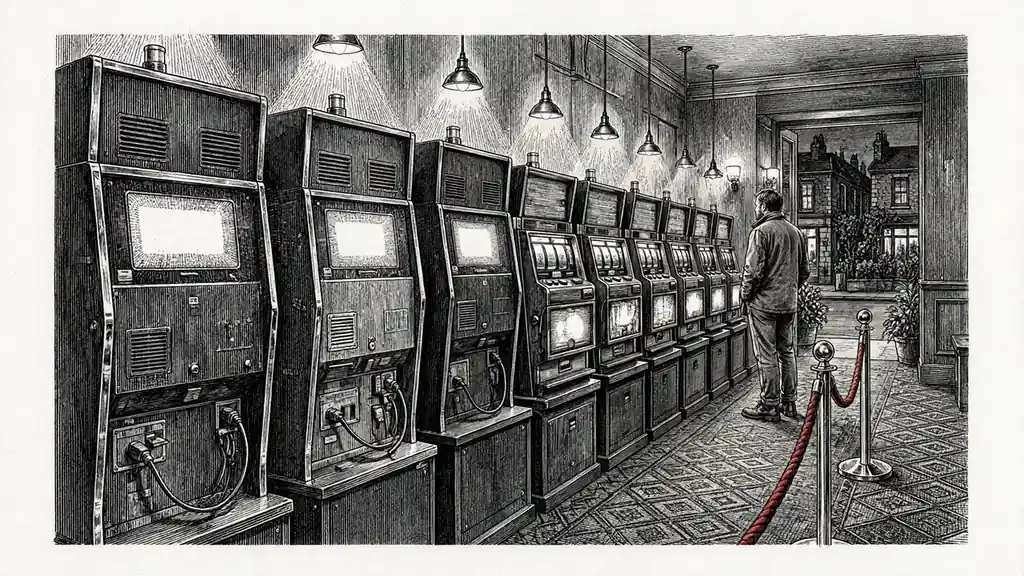
A video slot machine can look familiar before you press anything: symbols sit in rows, a spin control is close at hand, and the screen is built around one game. Online, that same cabinet-shaped idea becomes a display on your computer or phone. The physical controls are replaced by buttons on screen; the basic point is still to start a game cycle and see what appears.
That resemblance is useful, but it can also mislead. A cabinet has a visible body and fixed controls, while an online slot is software presented through a screen. Its artwork, sound and buttons belong to the game interface. They do not tell you what a spin will return. I treat the cabinet as a familiar way to picture the format, not as proof that an online game behaves like a particular machine.
The phrase “video slot machines” can describe either physical cabinets or online games, depending on context. If you are browsing a casino site, check the game itself rather than relying on a machine-style image. The screen may show a cabinet, a fruit machine or something entirely different; the visual setting is presentation, not a guide to the game’s financial outcome.
What carries across is the simple arrangement: choose the game, set the available stake, then start a cycle using its controls. Online play adds a screen-based interface, but it does not turn the slot into a different kind of gambling. The game still has its own rules and possible results, which are shown in its information panel.
I find the comparison handy for newcomers: imagine the familiar cabinet, then remove the casing and buttons. What remains is the game on screen. Simple enough.